
Tadhg Ó Ciardha
Threads of Moral Treatment: Making, Wearing & Photographing Patient Dress and Textiles in the Richmond Lunatic Asylum, Dublin 1814–1914
The dress of the psychiatric patient, historical or contemporary, is too often reduced to a cheap Halloween costume.
Building on the growing international body of research on the material culture of psychiatric institutions, my thesis, supervised by Dr Lisa Godson, comprises a historical study of the Richmond Lunatic Asylum (now TUD, Grangegorman), over its first hundred years of existence as the first public psychiatric hospital in Ireland, through the lens of dress and textiles. Described by Jean-Louis Roche in the Bulletin de Psychologie in 1976 as one of the "master-objects" of the psychiatric institution; clothing not only dictates sensory and psychological experience for patients, but foregrounds power relations between patient/staff, the sick/the healthy, and the inside/outside world. As one reporter wrote in the Freeman's Journal, after attending the Richmond Asylum's Annual Sports Day in September 1882: "Indeed, only for their garments, most of them would have been indistinguishable from the guests, and I was not long amongst them before I mentally blest [sic] the uniform.” Patient clothing and the questions surrounding its provision and production touch on every aspect of the therapeutic program, lived experience, and administration of the Richmond Asylum during the 19th century.
With the kind permission of the HSE and Dr Brendan Kelly, I have been given access to the surviving medical records from Grangegorman in the National Archives of Ireland. At the time of its foundation, the Richmond Asylum aspired toward the principles of Moral Treatment, a therapeutic methodology developed by reformers like the Quaker Tuke family in England and Phillipe Pinel in France. One of these principles was an emphasis on the restorative potential of occupational activity, including the manufacture of clothing and textiles by patients, as begun at the Richmond Asylum in the 1820s. Through the examination of surviving administrative and financial documents, I have been able to undertake a critical and ethical analysis of this system of production, as an expression of both economic and ideological concerns. Through these documents, as well as through published reports, I have also been able to gain a better understanding of the gendered division of patient craft labour, the kinds of clothing and textiles that were produced or bought at different points in time, and the impact of technological changes in production.
Casebooks, compiled from the second half of the 19th century onward, provide a rare glimpse into the patient experience at the Richmond Asylum, containing within their notes of medical observation, direct quotations from patients and sometimes even letters written in a patient's own hand, frequently littered with patients' impassioned pleas for the return of their own clothing. One aspect of this research that has been most moving is the examination of the role that clothing played in the institutional experience of patients whose gender, sex or sexuality fell outside cis-heteronormative expectations. The inclusion of photographs in the Casebooks, showing patients in the dress of the Asylum, beginning in the 1890s, provides a vital visual resource for this study. These have allowed me to conduct an in-depth study of the construction of garments and the textiles employed, assessing the impact of practicality, economics and fashion on the design of patient dress.
My use of drawing as a research methodology in engaging with these photographs is not only in the service of the study of dress, but a creative act which aims to make more of this archive accessible to the public in a way that respects patient confidentiality and dignity. I plan to organise an exhibition of these works after graduation.
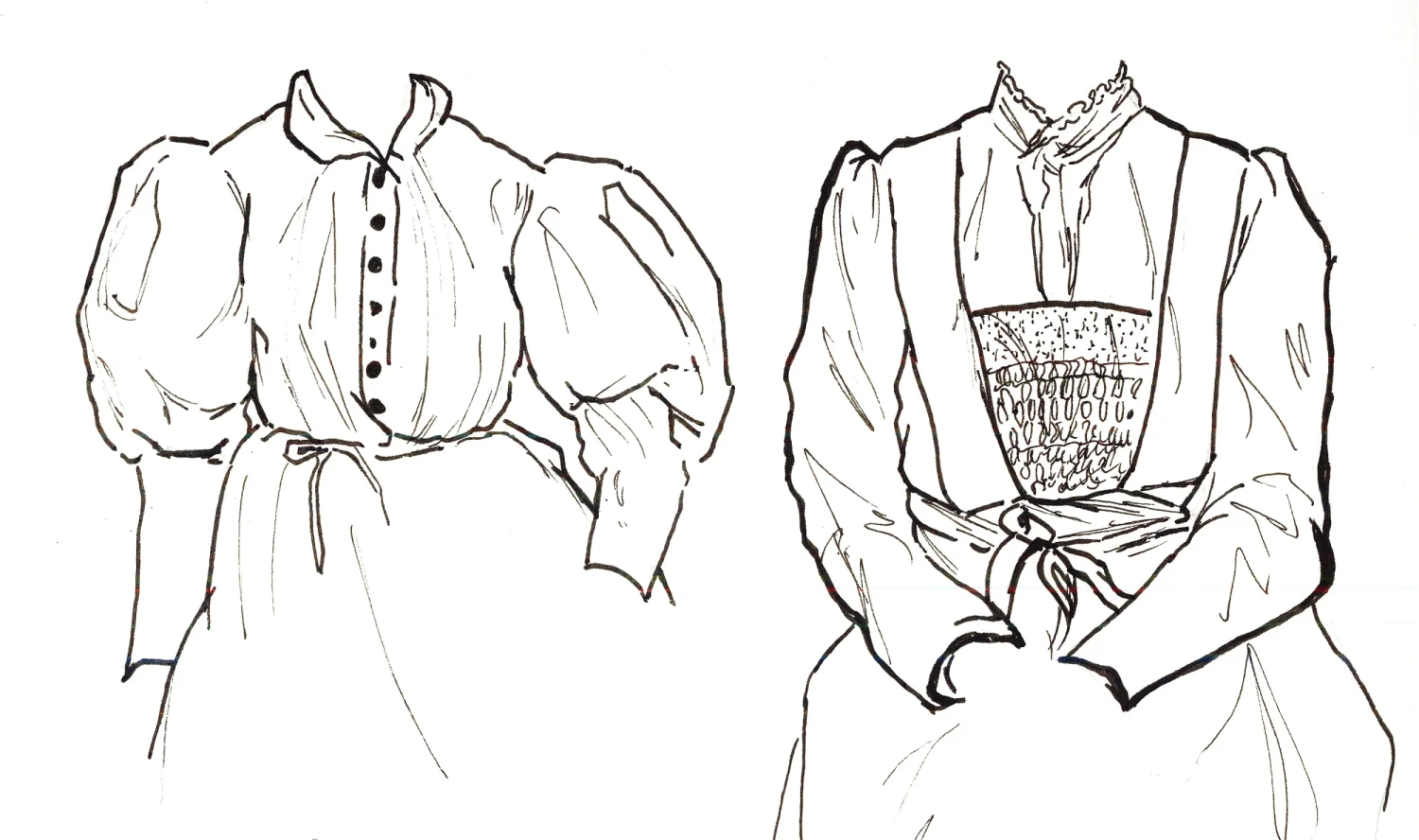
Summer dresses of 1896 and 1901, pen on paper, 2026. ©Tadhg Ó Ciardha
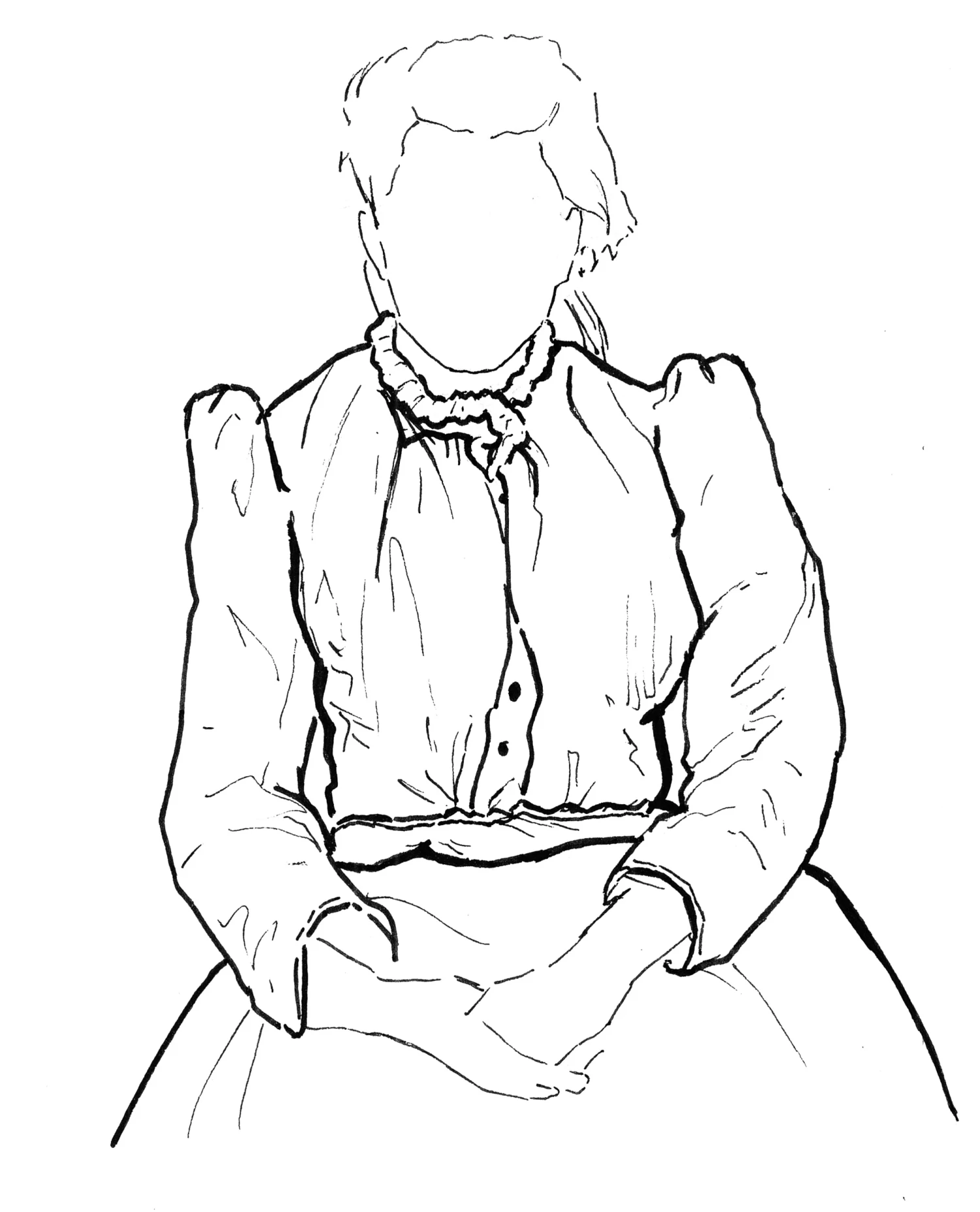
Patient Dress, March 1896, pen on paper, 2026. ©Tadhg Ó Ciardha